On November 11, 2015 I participated in a #PKMChat called, “Van Gogh on Learning” https://kneaver.com/blog/2015/11/pkmchat-van-gogh-on-learning/ it intrigued me as both a knowledge management professional and an artist and definitely gave me something to reflect on over the last week.
(Note: the #PKMChat was based on work that Ger Driesen is doing, he facilitated the #PKMChat along with Bruno Winck, more about Ger’s work can be found by clicking on the link in #2 in the references listed below)
I have been investigating the linkages between/among creativity, innovation, and knowledge management for more than three years, picking up ideas along the way, and experimenting and talking to people. Informally, there seems to be an agreement that there is a connection among the three things, but it’s in the background, below the surface, not immediately obvious to a lot of people. The #PKMChat helped shed some light on these linkages for me, so I am sharing them with you.
There are three main ideas that we discussed in the #PKMChat,
- Thinking inside the box
- Practice
- Reflection
As well as some secondary topics, like qualities of an artist, and how to balance social vs. solo learning.
One of the first things I noticed about comments on the #PKMChat was the perception that artists have a different perspective, that they are more inclined to experiment, and that there is a natural curiosity in being creative. Certainly this echoes other articles and books I’ve come across and was one of the reasons for Xerox’s artist in residence program in the 1990’s.
Thinking inside the box, I found this a bit hard to take initially, because I like thinking outside the box. I think that’s one of the advantages/benefits of KM, on a macro level it advocates diversity of thought, and learning from other industries or sectors, so the idea of “thinking inside the box” seemed counter-intuitive to me. But what this was really getting at was the idea that constraints build creativity and that often “the answer is right in front of you.” “Right in front of you” in this case could mean that there is someone in your organization that could provide knowledge or expertise or perhaps the knowledge you seek is in that repository or lessons learned system.
One of the themes that came up throughout the #PKMChat was the idea to take time to reflect and be curious, to challenge assumptions, to think critically about a challenge that is being faced. This was true in the discussion around thinking inside the box, too. Taking the time to look around your box and see what you have that might provide insight or an answer.
Practice, is critical to learning, for it is in practicing that we find the best solution and refine our techniques, whether we are artists, programmers, building cars, oil wells, or solar panels. Van Gogh practiced drawing heads, hands, and working with colour in order to get his style refined to what is easily recognizable today. Here we consider the 70-20-10 rule for managerial learning. Morgan McCall, Robert Eichinger and Michael Lombardo in their 1996 book, “The Career Architect” assert that 70% of the learning a successful manager does comes from doing, 20% comes from others, and 10% comes from formal education (books and classes). Practice makes perfect, as they say, but the chat participants also recognized that there is a point where perfection stops forward momentum and “good enough” is good enough.
Reflection, as I mentioned a moment ago reflection came up throughout the chat, even when it wasn’t the main topic of discussion. The consensus when it was the topic was that it was key to learning; that it allowed informed improvements to be made in future iterations of an activity rather than doing the same thing repeatedly. There was recognition that it needed to be part of the flow of the project of process and that the activity wasn’t complete until the reflection had taken place.
Van Gogh and artists reflect on their paintings and processes, on what they like or don’t like, what can be improved to more adequately reflect what they are trying to convey in their works.
Finally, we discussed social versus solo learning. There is a benefit to discussing work with others, whether, as in Van Gogh’s case he was writing to his brother, and talking with other artists or we are struggling with a new project we’ve been assigned to and look for others who have worked on similar initiatives before or talk to our friends/family about how they might approach the situation. The consensus here was that it was important to balance solo and social, and that balance was up to the individual to determine. Discussing things with others helps facilitate the challenging of assumptions because the other person/people aren’t as close to the problem as the person working directly on it so they might see things that we are too close to see.
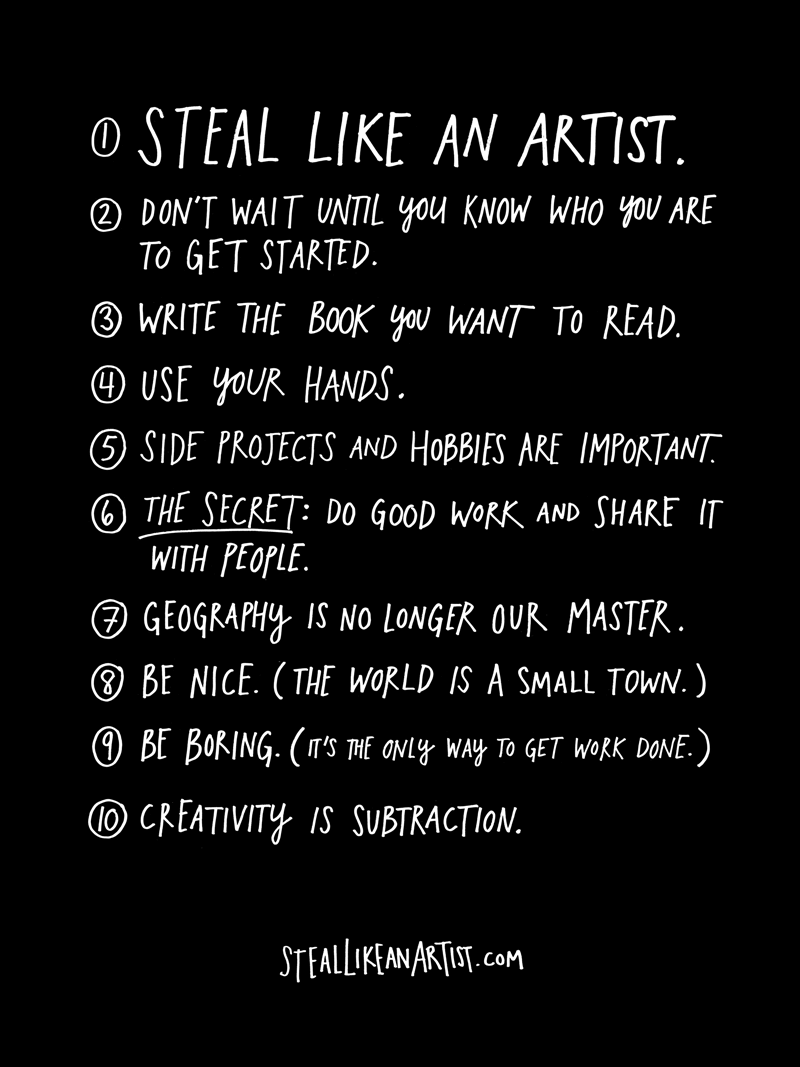
One of the things that got mentioned a couple of times during the chat was the book, “Steal Like an Artist.” The book talks about 10 items but the first one is most relevant at this point, “steal like an artist.” Everything an artist does is based on what’s come before, something someone else has done. While it’s true that an individual artist may combine processes, techniques, and materials in a way that hasn’t been done before, or have their own style, they are building on something they have learned by doing or by being taught.
The question for me after all of this is: where does this fit with the work that I have been doing?
It’s clear that there is a linkage; artists use some of the same processes and activities that organizations do to learn and make better use of knowledge and experience (e.g. reflection, lessons learned, communities). They do it on an individual basis, rather than a group/organizational basis, but that’s just a matter of scale and rigour around the activities.
What else? Does creativity and the processes it utilizes lead to innovation? Certainly the participants in the chat seemed to think so, there was agreement that being creative lead to asking more questions, and challenging the status quo and that this impact was felt regardless of the field people worked in, i.e., non-artists and artists alike believed that either being exposed to art or participating in an artistic practice made them more curious and open to experimentation.
Creativity leads to innovation, both are facilitated by knowledge management practices, and both contribute artefacts that build the knowledge base of an individual or an organization.
References:
- Xerox case study about their artist in residence program, https://www.amazon.com/Art-Innovation-Artist-Residence-Leonardo/dp/0262082756
- Learning Solutions Magazine article on Van Gogh as a painter and learning coach https://www.learningsolutionsmag.com/articles/1560/emea-reporter-vincent-van-goghpainterand-learning-coach
- Jay Cross blog post on implementing 70-20-10 for learning, https://www.internettime.com/2013/02/50-suggestions-for-implementing-70-20-10/
- Steal Like an Artist book, https://austinkleon.com/steal/
- Steal like an Artist list https://www.austinkleon.com/wp-content/uploads/2011/09/poster-0.gif
- Steal Like an Artist workshop on Slideshare, https://www.slideshare.net/pederrudbeck/steal-like-an-artist-workshop-uxstoriesdk