
I wrote a guest blog for Noddle Pod about Communities of Practice and Trust, you can check it out on their webpage https://www.noddlepod.com/2016/01/26/cop_trust.html?utm_content=buffer2ac25&utm_medium=social&utm_source=twitter.com&utm_campaign=buffer
Knowledge Management and Finance/Accounting
Some of you, who know me, will know that I started out my career in accounting; I have an undergraduate degree in accounting and was going to be a Chartered Accountant.
This is also how I got my start in KM, although it wasn’t called KM then, it was just how you worked—checklists and reusing last year’s files, talking to the staff who had worked on the audit/tax last year. If you had worked on the engagement the year before you were expected to be quicker in the subsequent year(s) because you were familiar with the client and the file.
15+ years into my knowledge management career, I still run into organizations that think that in order to help them better manage their knowledge that I have to be a specialist in whatever their content is, e.g. if it’s a law firm, I have to be a lawyer, if it’s a manufacturer I have to be an engineer, if it’s a hospital I have to be a doctor or a nurse or some other medical professional.
This isn’t always true, there are lots of organizations that understand that KM is a series of processes and activities, largely independent of the content. Organizations that understand having a depth of experience in how to get people to participate in knowledge sharing activities is more important than knowing the knowledge that they are actually supposed to be sharing.
Accounting is accounting is accounting. Yes, there might be some differences from industry to industry or sector, but in the end you are still trying to keep track of the financial resources of the organization, using generally accepted accounting principles.
Knowledge Management is no different. You are just trying to help facilitate the knowledge lifecycle from creation to sharing and management to disposal using a set of generally accepted knowledge management processes.
In both cases it’s important to understand the processes and principles, not the content.
Learning and Keeping an Open Mind
Back before Christmas, I tweeted about the necessity of keeping an open mind in order to learn, it was part of the #PKMChat, but it got picked up by several people who weren’t part of the chat, which is nice, because it means that people were reading my tweets even though they weren’t part of the chat that I was participating in.
It got me thinking about why I tweeted that, and how important it really is, to keep an open mind, and not pre-judge something or someone.
I was delivering a series of training sessions for a client a couple of years ago, and I said to them, “imagine if that’s not true.” I was trying to get them to think outside of the box, to imagine that whatever they had assumed was the answer wasn’t. What assumptions were they making, why did they think that something was true when it might not have been?
Some of them had a great deal of difficulty with this notion, that there wasn’t a right answer, that what they were sure was true wasn’t. No amount of challenges from me was going to change their minds.
It got me thinking, there are a lot of people like this in the world, I have been one myself in the past, and there are some days I probably still am this way, but I like to think that I am more open minded now. I have travelled more, talked to more people, had more life experiences, and learned that there are lots of different ways to approach the same challenge because I’ve seen it happen and experienced it personally.
How did this happen for me? Somewhere along the line, I ran out of “answers” and had to go looking, asking questions, recognizing assumptions that I was making, recognizing that things people had told me were true and necessary, were not. It was a hard realization to come to, but I’m better for it.
Keeping and open mind and questioning is key to learning, critical thought is key to learning: don’t just regurgitate what someone else has said. It’s hard and it takes a lot of work, but it’s worth it in the end.
Importance of a KM Strategy
Why do I need a knowledge management strategy? Why can’t I just implement some technology and be done with it? Why can’t I just implement Communities of Practice or Lessons Learned and be done with it?
I hear this sometimes from managers who want a quick fix, who are under a lot of pressure from time and resources (money and people).
The answer is, you can. I have worked with many organizations that have done just that, jumped in with both feet and “just done something”. I am usually there to fix it. Fix the technology because no one understood what it really needed to do to support knowledge work within the organization; fix the process because no one understands it and it’s not aligned with the rest of the activities in the organization and it’s created extra work for already over-worked staff.
Why do you need a strategy?
Would you jump in the car and set out on a journey of 5000km/3000miles without having some idea of where you were going and how you going to get there? Making sure that you had selected the right vehicle to get you there in time and a map to help direct you along the way?
A KM strategy does just that. It helps you figure out where you’re going, and the things you need to do along the way, the processes you need to support you and that need to be supported.
That’s not to say that you won’t make adjustments along the way, just like a friend of mine who drove from Toronto to Vancouver in September 2015, who ended up “detouring” through the United States, so that she could see some different sites, but she still knew where she was going and when she had to be there by—she made it with time to spare.
Isn’t that what you want from your KM strategy? To know where you’re going and how you want to get there, to meet the goals and objectives of the organization?
Why would you put a toaster over in the car for your trip, when you really needed a camp stove?
Why would you choose one technology because “everyone else is” when another technology is cheaper and better meets the needs of the organization because it requires less customization than the more popular software?
Isn’t it time you created (or updated) your KM strategy?
January 2016: The Story so Far, KM and Creativity
[Note: I originally wrote this article for the International Atomic Energy Agency’s Nuclear Knowledge Management wiki, which can be accessed here: https://wiki-nkm.iaea.org/wiki/index.php/The_IAEA_Wiki_on_Nuclear_Knowledge_Management]
Creativity and Knowledge Management
Introduction, definitions, background
Knowledge management and creativity would seem to be two completely different ideas and disciplines, but in fact they can and do enable and enrich each other and in the process of doing that enhance innovation.
Knowledge management is defined as: the process of capturing, developing, sharing, and effectively using organizational knowledge. It refers to a multi-disciplinary approach to achieving organizational objectives by making the best use of knowledge.
Creativity is defined as: the ability to transcend traditional ideas, rules, patterns, relationships, or the like, and to create meaningful new ideas, forms, methods, interpretations, etc.; originality, progressiveness, or imagination: the need for creativity in modern industry; creativity in the performing arts. Another definition says that creativity is the reorganization of experience into new configurations: a function of knowledge, imagination, and evaluation.
Innovation is defined as: a new idea, more effective device or process, it can be viewed as the application of better solutions that meet new requirements, unarticulated needs, or existing market needs. The term innovation can be defined as something original and more effective and, as a consequence, new, that “breaks into” the market or society.
According to “inGenius: A Crash Course on Creativity,” by Tina Seelig, creativity can be learned.
Nonaka discusses the idea of “ba” in his book, “The Knowledge Creating Company,” as well as other published articles; “ba” is the idea of making space for (knowledge) creation. This idea of space is through the use of physical and/or virtual space, and includes the idea of (emergent) relationships and mental/intellectual/emotional space (reflection, and just being).
Connection between creativity and knowledge management
Knowledge management is the set of tools that underlies any knowledge-based activity; everything is knowledge-based. The question is how to facilitate, enhance, and improve efficiency and effectiveness of any process/activity through the use of knowledge management activities.
Improved efficiency and effectiveness comes from finding new, creative, innovative solutions. How do we do this?
Two books can give us insights on solving this problem. The first is in the process of being written, the other was published in 2000. The book that is in the process of being written is by Ger Driesen and is about what we can learn about learning from Vincent Van Gogh; the second was written by Michael J. Gelb and is entitled, “How to Think Like Leonardo da Vinci: Seven Steps to Genius Every Day.”
From Van Gogh we learn:
- Think inside the box (apply scarcity/constraints)
- Practice/study
- Reflect
- Understand your own story/motivation
- When you master a level change the rules
- Value solitude, not loneliness
- Circumstances: join them or beat them
From Leonard da Vinci we learn:
- Curiosity
- Independent thinking/diversity
- Sharpen your senses (listen/mindfulness, appreciate beauty)
- Embrace uncertainty
- Balance logic and imagination
- Balance body and mind
- Make new connections
To do these things we need to have the space, or as Nonaka identified, the Ba for knowledge creation.
Using these activities as well as specific knowledge management activities to aid in innovation helps us to move between the organized knowledge and the unorganized knowledge that exists. The KM activities that aid in innovation are:
- Business driven action learning (learn through doing)
- Coaching and mentoring
- Communities of practice
- External assessment and benchmarking
- Knowledge capture from projects
- Knowledge exchange
- Knowledge harvesting from individuals
- Lessons learned
- Peer assists
- Project learning
- Organizational Learning, Training
Organized knowledge includes things that have been documented, in books, journals, repositories, libraries, databases, and slide decks, that we know/have access to. Whereas unorganized knowledge is knowledge that hasn’t been discovered yet either because the experiments haven’t been preformed or it resides in the heads of people we haven’t met yet.
What allows us to pass back and forth between organized and unorganized is the use of critical thinking. Critical thinking allows us to question what we know and to ask questions to discover new knowledge, but it also allows us to take the new knowledge and organize it into new or existing models. Critical thinking allows us to apply “the rules” but it also allows us to question and break “the rules” in order to make new discoveries and learn.
Additionally, we can use creativity and innovation to enhance knowledge management; we do this by applying critical thinking to our knowledge management activities. For example, instead of just looking at other similar projects that have been done within our organization or industry and learning from them, we can think critically about other industries that might have had a similar strategic issue and how they solved it. A nuclear power plant may learn how to resolve a training issue from the automotive industry or from an NGO who also struggled with just-in-time training delivery. Alternatively, what results have we discovered in participating in a Community of Practice, in a Peer Assist, or After Action Review how does this impact what we already thought we knew?
Critical Thinking
Critical thinking is the objective analysis and evaluation of an issue in order to form a judgment. It underlies all of knowledge management; it is what pushes us to learn. Asking “why” 5 times will help us get to the root of a problem or understanding our assumptions and asking, “what if that’s not true?” can also help use to see things differently, to look at things from a different perspective. Without the ability to think/reflect on and to question our experiences the whole foundation of knowledge management crumbles.
Critical thinking encourages us to keep an open mind and gather information and evidence before coming to a conclusion.
Creative Pursuits
There are three main types of creative domains:
- Art (ah!) as in beauty
- Discovery (aha!) as in enlightenment
- Humor (haha!) as in joyful pleasure
Art as in beauty ties into one of the items that we can learn from Leonardo da Vinci, about sharpening your senses, which is really about paying attention, listening, and observing the world around you. Art (painting, sculpture, music, literature, and dance) in this case helps to think about and observe, to ask questions about what you are seeing. In the case where you get involved in the creation of art, it magnifies this effect and can have a more significant impact on the outcome.
Making time to be creative in day-to-day life opens up possibilities, it can help you look at things differently.
Graphical Depiction
The figure below illustrates how all of these ideas fit together.

(c) Stephanie Barnes, Missing Puzzle Piece Consulting
Competitive Advantage
With the pace of change today it is imperative to be constantly improving and innovating in order to stay ahead of the competition and in the case of nuclear energy the competition isn’t just other nuclear energy producers, it is alternative energy generation methods. Creativity can help because it aids in looking at the problem/challenge differently and encourages using solutions that may have been developed in other organizations/industries.
References:
- HBR To Get More Creative Become Less Productive, https://hbr.org/2015/11/to-get-more-creative-become-less-productive
- Concept of Ba, https://www.cyberartsweb.org/cpace/ht/thonglipfei/ba_concept.html
- Definition of Knowledge Management, https://en.wikipedia.org/wiki/Knowledge_management#cite_note-2UNC-2, accessed on Dec 4, 2015 at 4;07pm CET.
- Definition of Creativity, https://dictionary.reference.com/browse/creativity, accessed on Dec 4, 2015 at 3:55pm CET.
- Definition of Innovation, https://en.wikipedia.org/wiki/Innovation, accessed on Dec 4, 2015 at 4:12pm.
- Genius: A Crash Course on Creativity by Tina Seelig, https://www.harpercollins.com/books/9780062020703, accessed December 4, 2015 at 4:25pm.
- Vincent van Gogh and Learning, https://www.learningsolutionsmag.com/articles/1560/emea-reporter-vincent-van-goghpainterand-learning-coach
- How to Think Like Leonardo da Vinci by Michael Gelb, https://michaelgelb.com/programs/how-to-think-like-leonardo-da-vinci/
- Critical Thinking on Wikipedia, https://en.wikipedia.org/wiki/Critical_thinking
- Developing Critical Thinking Through the Arts, https://www.visionsonlearningdifferences.com/main3.html
- Engaged Knowledge Management, https://www.palgrave.com/page/detail/engaged-knowledge-management-kevin-c-desouza/?isb=9781403945105
- Blog posts about Creativity and KM, https://missingpuzzlepiececonsulting.ca/category/creativity
- Creativity = Competitive Advantage, https://www.psychologytoday.com/blog/working-creativity/201109/creativity-competitive-advantage-0
- Creativity is the Next Competitive Advantage, https://enterprisearchitects.com/creativity-is-the-next-competitive-advantage/
- Swarm Creativity: Competitive Advantage through Collaborative Innovation Networks, https://www.oxfordscholarship.com/view/10.1093/acprof:oso/9780195304121.001.0001/acprof-9780195304121
- Collaborative Innovation Network on Wikipedia, https://en.wikipedia.org/wiki/Collaborative_innovation_network
What we can learn from Van Gogh for KM and Innovation
On November 11, 2015 I participated in a #PKMChat called, “Van Gogh on Learning” https://kneaver.com/blog/2015/11/pkmchat-van-gogh-on-learning/ it intrigued me as both a knowledge management professional and an artist and definitely gave me something to reflect on over the last week.
(Note: the #PKMChat was based on work that Ger Driesen is doing, he facilitated the #PKMChat along with Bruno Winck, more about Ger’s work can be found by clicking on the link in #2 in the references listed below)
I have been investigating the linkages between/among creativity, innovation, and knowledge management for more than three years, picking up ideas along the way, and experimenting and talking to people. Informally, there seems to be an agreement that there is a connection among the three things, but it’s in the background, below the surface, not immediately obvious to a lot of people. The #PKMChat helped shed some light on these linkages for me, so I am sharing them with you.
There are three main ideas that we discussed in the #PKMChat,
- Thinking inside the box
- Practice
- Reflection
As well as some secondary topics, like qualities of an artist, and how to balance social vs. solo learning.
One of the first things I noticed about comments on the #PKMChat was the perception that artists have a different perspective, that they are more inclined to experiment, and that there is a natural curiosity in being creative. Certainly this echoes other articles and books I’ve come across and was one of the reasons for Xerox’s artist in residence program in the 1990’s.
Thinking inside the box, I found this a bit hard to take initially, because I like thinking outside the box. I think that’s one of the advantages/benefits of KM, on a macro level it advocates diversity of thought, and learning from other industries or sectors, so the idea of “thinking inside the box” seemed counter-intuitive to me. But what this was really getting at was the idea that constraints build creativity and that often “the answer is right in front of you.” “Right in front of you” in this case could mean that there is someone in your organization that could provide knowledge or expertise or perhaps the knowledge you seek is in that repository or lessons learned system.
One of the themes that came up throughout the #PKMChat was the idea to take time to reflect and be curious, to challenge assumptions, to think critically about a challenge that is being faced. This was true in the discussion around thinking inside the box, too. Taking the time to look around your box and see what you have that might provide insight or an answer.
Practice, is critical to learning, for it is in practicing that we find the best solution and refine our techniques, whether we are artists, programmers, building cars, oil wells, or solar panels. Van Gogh practiced drawing heads, hands, and working with colour in order to get his style refined to what is easily recognizable today. Here we consider the 70-20-10 rule for managerial learning. Morgan McCall, Robert Eichinger and Michael Lombardo in their 1996 book, “The Career Architect” assert that 70% of the learning a successful manager does comes from doing, 20% comes from others, and 10% comes from formal education (books and classes). Practice makes perfect, as they say, but the chat participants also recognized that there is a point where perfection stops forward momentum and “good enough” is good enough.
Reflection, as I mentioned a moment ago reflection came up throughout the chat, even when it wasn’t the main topic of discussion. The consensus when it was the topic was that it was key to learning; that it allowed informed improvements to be made in future iterations of an activity rather than doing the same thing repeatedly. There was recognition that it needed to be part of the flow of the project of process and that the activity wasn’t complete until the reflection had taken place.
Van Gogh and artists reflect on their paintings and processes, on what they like or don’t like, what can be improved to more adequately reflect what they are trying to convey in their works.
Finally, we discussed social versus solo learning. There is a benefit to discussing work with others, whether, as in Van Gogh’s case he was writing to his brother, and talking with other artists or we are struggling with a new project we’ve been assigned to and look for others who have worked on similar initiatives before or talk to our friends/family about how they might approach the situation. The consensus here was that it was important to balance solo and social, and that balance was up to the individual to determine. Discussing things with others helps facilitate the challenging of assumptions because the other person/people aren’t as close to the problem as the person working directly on it so they might see things that we are too close to see.
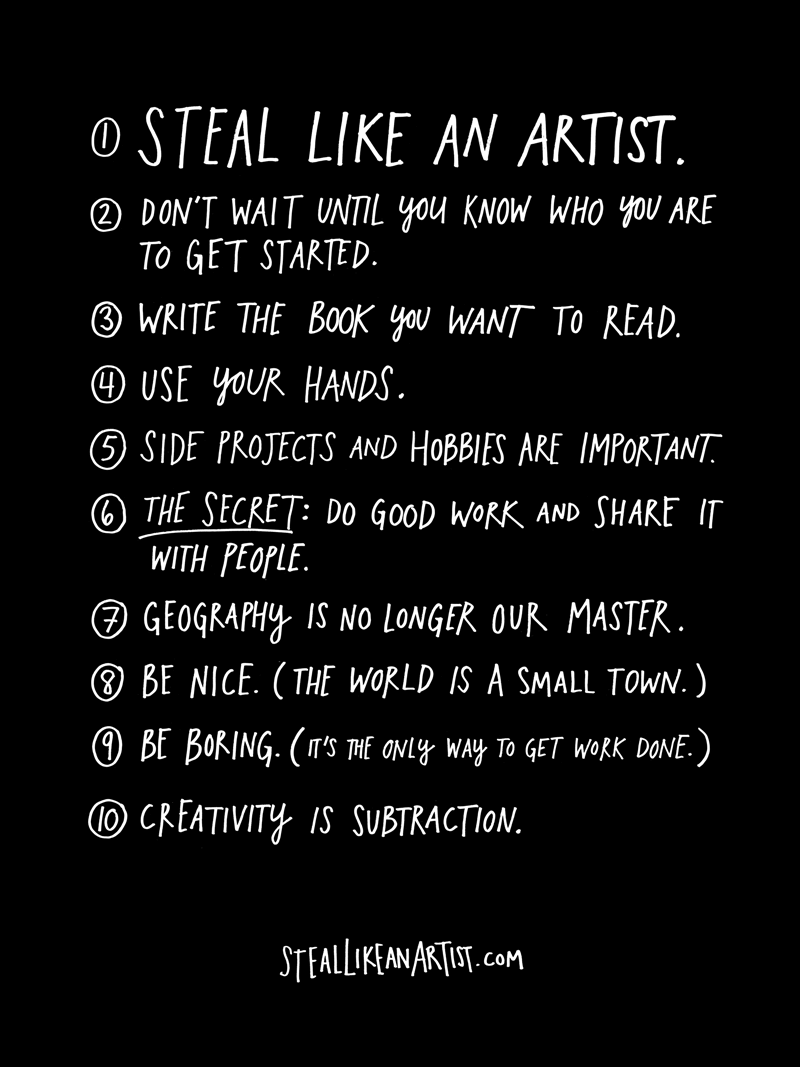
One of the things that got mentioned a couple of times during the chat was the book, “Steal Like an Artist.” The book talks about 10 items but the first one is most relevant at this point, “steal like an artist.” Everything an artist does is based on what’s come before, something someone else has done. While it’s true that an individual artist may combine processes, techniques, and materials in a way that hasn’t been done before, or have their own style, they are building on something they have learned by doing or by being taught.
The question for me after all of this is: where does this fit with the work that I have been doing?
It’s clear that there is a linkage; artists use some of the same processes and activities that organizations do to learn and make better use of knowledge and experience (e.g. reflection, lessons learned, communities). They do it on an individual basis, rather than a group/organizational basis, but that’s just a matter of scale and rigour around the activities.
What else? Does creativity and the processes it utilizes lead to innovation? Certainly the participants in the chat seemed to think so, there was agreement that being creative lead to asking more questions, and challenging the status quo and that this impact was felt regardless of the field people worked in, i.e., non-artists and artists alike believed that either being exposed to art or participating in an artistic practice made them more curious and open to experimentation.
Creativity leads to innovation, both are facilitated by knowledge management practices, and both contribute artefacts that build the knowledge base of an individual or an organization.
References:
- Xerox case study about their artist in residence program, https://www.amazon.com/Art-Innovation-Artist-Residence-Leonardo/dp/0262082756
- Learning Solutions Magazine article on Van Gogh as a painter and learning coach https://www.learningsolutionsmag.com/articles/1560/emea-reporter-vincent-van-goghpainterand-learning-coach
- Jay Cross blog post on implementing 70-20-10 for learning, https://www.internettime.com/2013/02/50-suggestions-for-implementing-70-20-10/
- Steal Like an Artist book, https://austinkleon.com/steal/
- Steal like an Artist list https://www.austinkleon.com/wp-content/uploads/2011/09/poster-0.gif
- Steal Like an Artist workshop on Slideshare, https://www.slideshare.net/pederrudbeck/steal-like-an-artist-workshop-uxstoriesdk
The Second KM Silver Bullet: One isn’t enough
As a friend of mine pointed out, it’s not enough to just create a strategy, it’s about the execution of that strategy.
And he’s right, strategies can sit on shelves, certainly I have had more than one client, that for various reasons did not implement the strategy we had developed together.
So what does it take to successfully implement a KM strategy?
A bunch of things, senior management buy-in and budget among them, but I would argue the most critical component, and the one that my friend posited, is Change Management.
There are many good books on Change Management by authors such as Peter Senge and John P. Kotter, to name two of my favourites. But what it all boils down to for me, is communication. Not just some manager decreeing, “thou shalt do knowledge management,” but a real conversation between the KM team and the rest of the organization. What do they need to be able to be effective in their jobs? How can the KM team help them? What do the users of the KM activities need to know about how to use the technology and the processes? What will aid them in their decision making and other things they are responsible for?
KM is there to serve the organization, to help it to be more efficient, effective, innovative, whatever the KM strategy identified as the business case for KM. It does that, in part, through the execution of the change management plan to support the transformational change that KM demands.
The KM Silver Bullet
KM is a lot of things to a lot of people.
It seems everyone wants the silver bullet, the one “right” answer to the question of how to be successful in KM.
Or they want the one “right” answer to the question of what is KM and what’s included in KM.
Well let me save you a lot of time and heartache, there is no one right answer, the answer is, it depends.
It depends on your organization’s strategy, objectives, culture, industry, regulations, size, budget, risk profile, staffing profile, technology strategy.
Figure out what KM is to your organization and create a strategy that supports that definition, that’s the silver bullet.
KM, Continuous Improvement, Process Re-engineering, and Six-Sigma
Last week (January 28-29, 2015) I was in Amsterdam for KM Legal Europe, I provided some thoughts on that in my previous blog. Also in that blog post I mentioned that the subject of where KM fits with Continuous Improvement, Process Re-engineering, and Six-Sigma came up. We had a discussion about it, but we ran out of time and I’m not sure that we really came to any conclusions.
First lets start off with some general definitions/explanations.
While Continuous Improvement, Process Re-engineering, and Six-Sigma are all different activities and initiatives, and there are books and courses on each of them separately for the purposes of this blog post I am going to group them all together because for the purposes of this discussion their touch-point with KM is the same. So what are they? They are activities that have the objective of aligning organizational processes with the needs and objectives of the organization. They seek to remove inefficiencies and streamline work processes; they aim for standardization and the reduction of variability.
Knowledge Management, on the other hand, is about learning and sharing, and making sure people have the knowledge they need to do their jobs.
On the face of it, it doesn’t seem that there is much in common, but as they say, “the devil is in the details.”
Let me ask you this, “why do we learn?” and “what are we hoping to accomplish by learning?” Some organizations will say to be more efficient and effective, provide better customer/client service, to be better at what we do, whether that is provide a product, service, economic development, or something else. Hmmm…don’t those sound similar to what Continuous Improvement, Process Re-engineering, and Six-Sigma are all about?
There are many ways to learn, Stan Garfield compiled a list of 80+ activities that can be considered KM activities. Where does learning overlap with Continuous Improvement, Process Re-engineering, and Six-Sigma? In my mind, it’s in the Lessons Learned processes and activities. In Lessons Learned we are trying to understand what worked, what didn’t work, what we should do differently next time and what we need to do to make sure “next time” is better than the last time. That sounds like Continuous Improvement, Process Re-engineering, and Six-Sigma to me.
Now in Continuous Improvement, Process Re-engineering, and Six-Sigma we may actually create the redesigned process. Whereas in Lessons Learned we may recognize that the process needs to be redesigned or a checklist created or some other such outcome and kick-off a sub-process that does the creation. But the Lessons Learned process does do a check and ensure that the outcome was completed and implemented, thus closing the loop on the whole cycle.
I know I have over simplified this, but I do believe the two sets of activities are very closely linked, and I wanted to get across that it’s just a change in perspective that’s needed.
KM isn’t something separate from everything else, it’s a key component of everything and recognizing that makes the implementation that much more complete.
Notes from KM Legal Europe January 2015
I attended KM Legal Europe last week in Amsterdam; I enjoyed the conference very much. I got to talk with many of the speakers and attendees and learn more about what the law firms and corporate legal departments in Europe are doing in the KM space. I was impressed by their thoughtfulness and recognition of the fact that KM can bring them efficiencies and effectiveness as well as innovations and competitive advantage. They were a passionate group of practitioners.
While KM in law tends to focus on documented knowledge because of the nature of the sector and the need to track matters and precedents, there were discussions of lessons learned and sharing tacit knowledge too.
One of the things that (pleasantly) surprised me, was the discussion of automated document creation, when I have spoken with other organizations (not just law firms) about this technology they haven’t even known what it was, so to sit in a room where many were enthusiastic users was refreshing.
Other things that I found refreshing were the discussion of continuous improvement, six sigma, and process re-engineering. Again, all things that utilize an organization’s knowledge and especially, at least in my mind, the use of lessons learned processes and activities. This probably deserves its own blog post, as the participants were quite interested in this area and unfortunately we ran out of time.
One final thing that I found gratifying was the group’s willingness to not only share and learn from each other, but the interest in my experience working in other industries and sectors. They seemed to recognize that KM is KM and that they were behind many other sectors, so there were many things that they could learn from those who have gone before them.
All-in-all a wonderful few days with wonderful people, so glad I was able to take part.